
Why a Trusted Master Data Foundation Is Critical for ESG Compliance and Supply Chain Transparency
Sustainability reporting has moved from a brand-building exercise to a board-level requirement. As regulations tighten, investors ask harder questions, and customers expect greater transparency, organizations are under growing pressure to show not only what they report, but whether the data behind those claims can be trusted.
Yet as companies roll out ambitious sustainability frameworks, many discover that the hardest part of ESG disclosure is not producing the final report. It is collecting consistent, accessible, and reliable data from the systems, teams, and partners that feed it. Without that trusted foundation, even sophisticated reporting tools can produce gaps, inconsistencies, or insights that are difficult to defend.
The Hidden Complexity of Sustainability Data
For industrial organizations and manufacturers, capturing accurate sustainability metrics is uniquely complex. Unlike financial data, which follows standardized accounting practices and lives within well-defined ERP systems, ESG data is notoriously fragmented across global operations.
A single product’s environmental impact relies on data points scattered across multiple departments, legacy software, spreadsheets, and third-party vendor systems:
· Scope 1 & 2 Emissions: Requires accurate energy usage, fuel consumption, and facility-level operational monitoring.
· Scope 3 Emissions: Demands deep visibility into multi-tiered, global supply chains, raw material origin, and freight logistics.
· Product Circularity: Depends on precise Bill of Materials (BOM) data, recyclability metrics, and comprehensive lifecycle assessments.
When this data resides in silos or relies on manual collection, reporting becomes slower, more error-prone, and more expensive. It can also increase the risk of inconsistent disclosures, accidental greenwashing concerns, and compliance challenges if the underlying evidence cannot be traced or verified.
Building a Trusted Data Foundation with Xpert Data Works
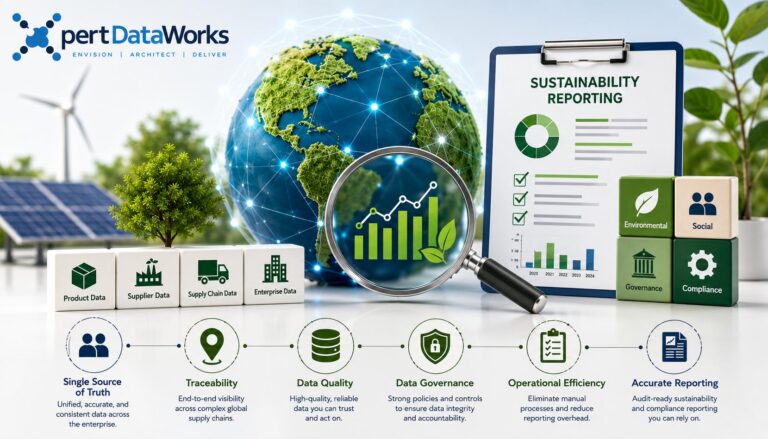
At Xpert Data Works, we believe that sustainable business practices must begin with trusted data. You cannot manage what you cannot accurately measure, and you cannot measure what you cannot see. To turn sustainability reporting into a strategic advantage, manufacturers must establish a strong data foundation built on five core pillars:
1. Single Source of Truth
Fragmented data leads to conflicting reports and internal confusion. Unifying product, supplier, and enterprise data into a centralized repository eliminates duplicate records and ensures that every department operates from the exact same baseline facts.
2. Multi-Tier Supply Chain Traceability
For many manufacturers, Scope 3 emissions can represent a significant share of the overall footprint. Improving sustainability performance often requires visibility beyond primary suppliers, and structured data mapping can support traceability across complex supply chains while making supplier compliance easier to measure.
3. Enterprise Data Governance at Scale
Data constantly moves and degrades if left unmanaged. Automated data governance frameworks validate, clean, and enrich incoming data continuously. Setting clear rules for data ownership ensures that reporting remains reliable as your enterprise scales.
4. Elimination of Manual Collection Inefficiencies
Relying on static spreadsheets and endless email chains to collect sustainability metrics wastes valuable engineering and management hours. Automating data ingestion from IoT devices, ERPs, and supplier portals eliminates human error and frees teams to focus on strategy.
5. Audit-Ready Compliance Reporting
Regulators and auditors are increasingly applying greater scrutiny to ESG disclosures. A robust data architecture helps maintain clear audit trails by documenting where a data point originated, who updated it, and how calculations were performed—making compliance reporting more transparent and easier to support.
Moving Beyond Compliance to Competitive Advantage
While meeting regulatory mandates like the CSRD or SEC climate disclosures is necessary, sustainability reporting should do far more than satisfy legal requirements. When powered by clean, reliable master data, ESG reporting transitions from a cost center into a powerful business driver.
Legacy Reporting Approach | Trusted Data Approach |
Reactive & Disconnected | Proactive & Integrated |
Risk-Focused & Error-Prone | Value-Focused & Credible |
A solid data foundation empowers executive leadership to make better, faster operational decisions. It helps supply chain managers pinpoint inefficient logistics routes, assists product designers in selecting lower-impact materials, and builds authentic confidence among stakeholders.
Credibility Starts with Data Quality
At the end of the day, a glossy sustainability report means very little if the metrics behind it cannot stand up to scrutiny. Stakeholders are smarter and more critical than ever, and trust is easily lost when data fails to hold up under audit. When your data foundation is trusted, your sustainability story becomes credible, actionable, and impactful.
Ready to transform your ESG data strategy? |