
Ever felt like your recurring regulatory submissions are more about repeating past mistakes than demonstrating progress?
Imagine ordering food from your favorite restaurant.
You have ordered the same meal countless times, and your preferences are always consistent:
- No peanuts
- Less spicy
- Extra vegetables
- No onions
- Include cutlery
The first time, you take your sweet time explain everything but the restaurant forgets the “no peanuts” request. The next time you order, you explain it again. The meal is much spicier than requested. And the next time, you explain it again. The onions are included again. Every time, something is missed. You contact the restaurant and explain the problem, They correct the order. But when you order again, you have to repeat the same preferences all over again. The problem is not that the restaurant does not know what you want. The problem is that the right information is not being consistently carried through the process !!!
Now imagine the same scenario in Medical Device World, A Medical Device manufacturer / distributor preparing to submit thousands of products, hundreds of data attributes to multiple regulatory authorities. If there is just one single data element which is missing/incorrect this could involve rejection of devices from all qualified authorities. On top of it , multiple business teams need to be involved to review and resend the information with a delay of time taken for correction and review by MDR. For medical device organizations, this is not simply an inconvenience. It can consume valuable operational time, delay regulatory processes, and increase the risk of non-compliance. This is the challenge faced by organizations managing medical device information.
When Product Data Becomes a Regulatory Challenge
Medical device manufacturers and distributors are required to submit product information to regulatory bodies such as the FDA, EUDAMED, SWISSDAMED and so on. The information submitted must be accurate, complete, and aligned with applicable regulatory requirements. However, when information is incomplete or incorrect, the process can become similar to repeatedly placing the same food order—only to discover that the same preferences or requirements have once again been missed.
The organization may need to:
- Identify the issue
- Find the responsible team
- Correct the information
- Validate it again
- Resubmit the data
- Wait for further feedback
- If another issue is discovered, the cycle may begin again.
This can lead to repeated correction cycles, increased manual effort, delayed regulatory updates, and increased compliance risk.
What If the Information Could Be Validated Before It Reached the Regulatory Authority?
The solution brings together Informatica Product 360 and osapiens to support a more connected and proactive approach to medical device regulatory data management.
Product information can be managed and validated TWICE within the regulatory compliance process before submission, providing opportunity to identify and address potential issues with appropriate feedback messages in human readable format prior to submission
The objective is simple:
Do not keep asking the same questions and correcting the same problems repeatedly.
Instead, establish a process where important information is managed, validated, and carried forward more consistently.
The Story Does Not End After the Submission
Even after the data has been submitted, the process continues. Regulatory registries may review the information and provide feedback, comments, or error notifications. Just as a restaurant may need to respond when a customer reports that an order was not prepared according to their preferences, medical device organizations need to respond when regulatory feedback identifies an issue with submitted information.
The right business users and data stewards need to know:
- What is wrong?
- Which product is affected?
- What action is required?
- Who needs to address the issue?
Through an integrated approach, regulatory feedback can be monitored and connected back to the relevant business and data teams.
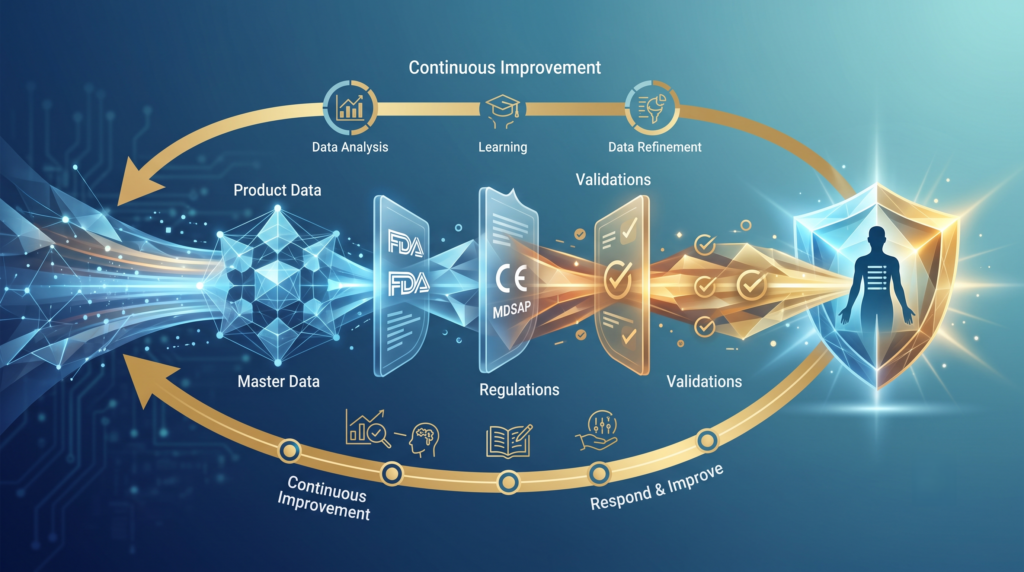
This creates a continuous feedback loop:
Manage → Validate → Submit → Monitor → Respond → Improve
From Repeating Corrections to Continuous Improvement
The objective is not simply to complete one successful submission. The larger goal is to improve the quality of regulatory product information over time. Each validation result and regulatory feedback cycle can help organizations identify opportunities to improve the underlying data and processes.
This can help deliver:
- Fewer repeated submission errors
- Faster resolution of regulatory feedback
- Better visibility into data issues
- Reduced manual monitoring
- Improved collaboration between business and data teams
- Stronger product data governance
- Greater confidence in regulatory submissions
The Bigger Picture
In everyday life, we expect our preferences and important information to be remembered and carried forward. If we repeatedly order the same meal, we do not expect to explain the same requirements from the beginning every time. We expect the process to become more consistent. The same principle applies to medical device regulatory data. Organizations should not have to repeatedly discover the same data issues only after submitting information to a regulatory body. A more proactive approach can help ensure that product information is validated before submission, regulatory feedback is monitored after submission, and the right teams are notified when action is required.
By combining Informatica Product 360 with osapienshub, organizations can establish a more connected approach to managing medical device product information and regulatory interactions.
The goal is to move from repeated correction cycles to a continuous process of data quality, regulatory visibility, and compliance improvement.
Because in the world of regulatory data, the goal should not be to keep correcting the same order.
The goal is to make sure the right information reaches the right destination—correctly, consistently, and with confidence.