
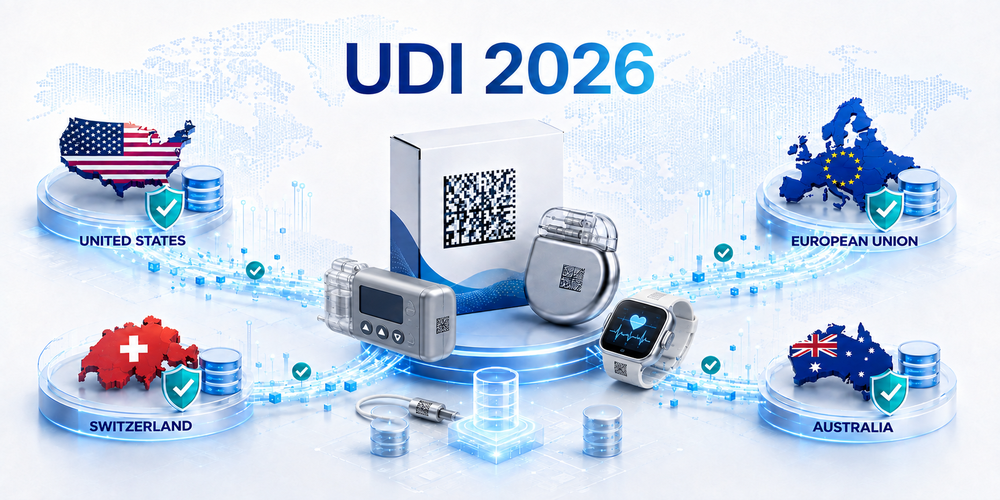
Moving from Database Filing to Global Product Data Governance
For medical device regulatory teams, compliance used to be a regional project. You prepared a submission for the US FDA’s GUDID, checked the box, and moved on to the next market.
That siloed approach is officially dead.
The year 2026 marks a decisive turning point in global Unique Device Identification (UDI) regulations. Key healthcare markets across Europe and the Asia-Pacific region have transitioned from voluntary soft launches to strict enforcement. As a result, maintaining UDI compliance is no longer just about filling out regional database forms—it is about managing an interconnected ecosystem of global product data.
For medical device manufacturers operating internationally, the core challenge has shifted from regulatory reporting to master data governance.
The Regulatory Tipping Point: What Changed in 2026?
Within a matter of weeks, three major global health authorities implemented mandatory UDI and device registration requirements, creating an unprecedented wave of enforcement across international supply chains.
May 28, 2026 European Union Mandatory EUDAMED UDI/Device Module | July 1, 2026 Switzerland Mandatory swissdamed Device Registration | July 1, 2026 Australia (TGA) Phased UDI for High-Risk (Class III / Implantables) |
- European Union: Mandatory EUDAMED UDI Module (May 28, 2026)
Following years of phased rollouts and voluntary submissions, the European Union’s EUDAMED UDI/Device registration module became legally mandatory on May 28, 2026. Device manufacturers placing products on the EU market must now ensure that their Basic UDI-DI and UDI-DI data are registered in EUDAMED prior to commercial distribution. - Switzerland: Swissdamed Enforcement (July 1, 2026)
Following its exit from the EU Single Market framework for medical devices, Swissmedic established its own medical device database, swissdamed. As of July 1, 2026, registering devices directly within the swissdamed database is mandatory, requiring manufacturers targeting the Swiss market to maintain parallel registrations alongside their EU filings. - Australia: TGA Phased Rollout (July 1, 2026)
Australia’s Therapeutic Goods Administration (TGA) formally launched its mandatory UDI framework on July 1, 2026. The initial phase targets high-risk medical devices (Class III and active implantable medical devices), requiring compliance across physical labels, packaging tiers, and Australia’s central UDI database.
The Core Challenge: The “Single Source of Truth” Problem
With the FDA GUDID, EU EUDAMED, Swissdamed, and Australia’s TGA UDI database all operating simultaneously, medical device companies face a structural dilemma: Data Fragmentation.
While international regulatory bodies aligned on the core principles of UDI, their technical specifications, localized attributes, and submission protocols remain distinct. A single medical device SKU may require dozens of identical core attributes (such as GTIN, brand name, and storage conditions), yet each jurisdiction requires specific regional extensions, distinct packaging level hierarchies, and localized language translations.
Managing these submissions through manual spreadsheets or disconnected ERP systems introduces severe risks:
- Mismatched Packaging & Database Records: Differences between physical label barcodes, IFUs (Instructions for Use), and public registry entries lead to immediate customs holds and regulatory audit findings.
- Redundant Data Maintenance: Updating a single product attribute (e.g., shelf life or storage temperature) currently requires manual re-entry across four or more distinct health authority databases.
- Version Control Cascades: A product update approved in one jurisdiction must be synchronized instantly across all global databases to avoid regulatory non-conformance.
Treating UDI as a “database-by-database” filing task creates operational bottlenecks and elevates non-compliance risks.
The Solution: Enterprise Product MDM & PIM Architecture
To navigate this multi-jurisdictional landscape smoothly, forward-thinking medical device leaders are shifting away from point-to-point database entries. The strategy revolves around governing a single, trusted source of truth.
By establishing an enterprise Product Master Data Management (MDM) and Product Information Management (PIM) architecture, organizations decouple data governance from regulatory distribution:
| Solution Architecture Layer | Function | Regulatory Impact |
|---|---|---|
| Master Data Core (PIM/MDM) | Centralizes global product attributes, packaging levels, and core UDI data elements. | Guarantees that physical label data matches global regulatory submissions identically. |
| Validation Engine | Validates data against regional rules (FDA, EUDAMED, swissdamed, TGA) before submission. | Eliminates submission rejections by identifying missing or formatted attributes automatically. |
| Automated Integration Connectors | Synergizes and pushes approved master records directly into target health authority databases via secure APIs. | Replaces manual data entry, reduces labor hours, and establishes an auditable change history. |
How Xpert Data Works Empowers Global Manufacturers
At Xpert Data Works, we understand that global regulatory compliance isn’t just a legal obligation—it is a data management discipline.
We help medical device manufacturers govern, validate, and synchronize complex UDI data across all major health authority platforms, including EUDAMED, FDA GUDID, swissdamed, and Australia’s TGA UDI framework.
Our unified framework integrates Product MDM, PIM, automated business rule validation, and seamless database integration. By establishing a single, highly governed master record for every product, we ensure that your physical packaging, regional submissions, and public registry records remain in lockstep—regardless of how fast global regulations evolve.
| Because in 2026 and beyond, sustainable global UDI compliance doesn’t start with a regulatory filing. It starts with one trusted source of product data. |