
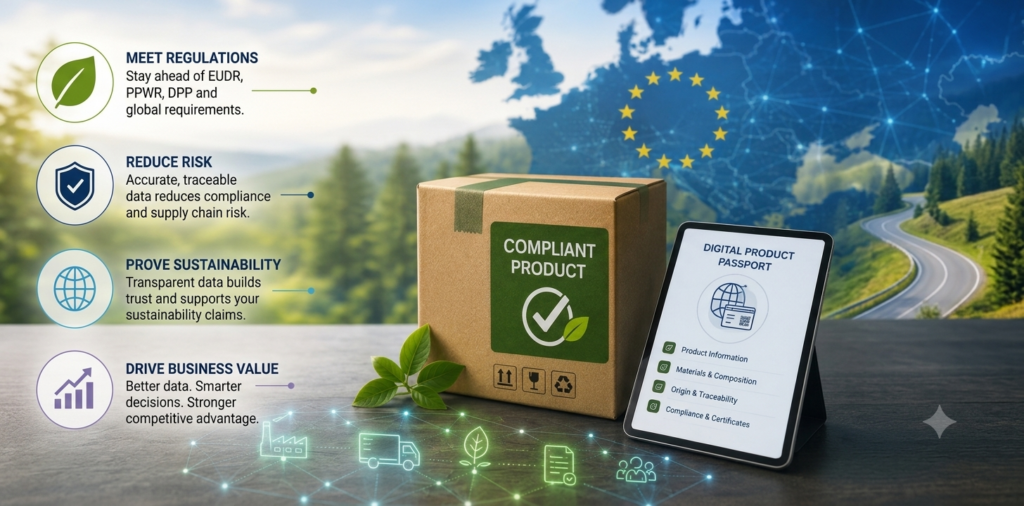
A strategic guide for global manufacturers navigating the EU Digital Product Passport (DPP) and EU Deforestation Regulation (EUDR).
For years, regulatory compliance across European markets felt like a distant milestone on a strategic roadmap. Environmental, Social, and Governance (ESG) frameworks were discussed in high-level board meetings, sustainability reports were published annually, and future-looking directives were treated as operational concerns for tomorrow.
That era has officially come to an end.
With the EU Digital Product Passport (DPP) Registry now live and the EU Deforestation Regulation (EUDR) application deadline rapidly approaching, regulatory compliance has shifted from a future initiative to an immediate operational necessity.
For global manufacturers, the message from regulators is loud, clear, and uncompromising: Compliance starts with your product data.
1. The New Regulatory Reality: DPP and EUDR
To understand the urgency, one must look at the regulatory landscape taking shape across the European Union.
The Digital Product Passport (DPP)
The EU’s Digital Product Passport is a core pillar of the Ecodesign for Sustainable Products Regulation (ESPR). Designed to foster a circular economy, the DPP requires products sold within the EU market to carry a scannable digital record containing comprehensive data regarding:
- Material Composition & Origin: Exact chemical, material, and source declarations across components.
- Environmental Footprint: Lifecycle carbon impact and environmental metric tracking.
- Circular Economy Metrics: Recyclability, repairability, and end-of-life disposal protocols.
- Supply Chain Traceability: Chain-of-custody documentation and third-party certifications.
With the DPP Registry live, the digital infrastructure supporting this vision is actively deploying.
EU Deforestation Regulation (EUDR)
Concurrently, the EUDR mandates that companies selling key commodities (such as timber, rubber, soy, cattle, cocoa, coffee, and oil palm) and derivative products into the EU must prove that these goods do not originate from recently deforested land or contribute to forest degradation.
Compliance requires precise geolocation data of production plots, rigorous due diligence statements, and full traceability down to the raw material source.
2. The 4 Critical Questions Every Manufacturer Must Answer
As these regulations take hold, compliance is no longer a matter of checking a box or submitting a high-level corporate pledge. Regulators and auditors now demand granular, verifiable proof.
If an auditor, customer, or regulatory authority reviewed your portfolio today, could your organization quickly and confidently answer these four questions?
- What materials are in your product?: Beyond high-level Bill of Materials (BOM) data, do you possess deep insight into exact chemical compositions, recycled content percentages, and hazardous substance declarations across every component?
- Where did they come from?: Can you trace every raw material back through its tier-N supply chain to its original point of harvest, extraction, or processing?
- Which suppliers are involved?: Do you have visibility into your extended vendor network, including lower-tier suppliers who manufacture components deep within your supply chain?
- Is the data accurate, traceable, and audit-ready?: Is your compliance data fragmented across static PDFs, isolated spreadsheets, and legacy ERP systems? Or is it unified, validated, and instantly accessible when requested?
3. The Danger of the “Last-Minute Scramble”
Historically, when a new regulation emerged, organizations reacted by treating it as an isolated administrative task. Compliance teams were tasked with manually emailing suppliers, collecting questionnaires, and assembling custom reports in spreadsheets.
This approach—the “last-minute scramble”—is no longer viable for several reasons:
- Complexity at Scale: Modern supply chains involve thousands of SKUs and multi-tiered supplier networks. Manual data collection simply cannot scale.
- Severe Financial & Operational Risks: Non-compliance carries heavy consequences, including substantial fines, confiscation of goods, and complete market access bans across the EU.
- Reputational Damage: Today’s B2B buyers and consumers demand transparency. Failing to provide accurate sustainability credentials erodes customer trust and market position.
4. Turning Compliance into a Strategic Business Capability
At Xpert Data Works, we believe manufacturers must fundamentally rethink how they approach regulatory demands. Compliance shouldn’t be viewed as an external burden or a reactive cost center; it should be built as a core operational capability.
The secret to achieving this transformation lies in your data strategy. When you seamlessly connect product data, supplier intelligence, and regulatory requirements, compliance stops being a periodic scramble and becomes an automated, continuous process.
Better Data → Better Compliance → Better Decisions
By establishing robust data architecture and governance, manufacturers gain far more than mere regulatory adherence:
- Supply Chain Resiliency: Deep visibility into lower-tier suppliers allows you to identify supply chain risks, bottlenecks, and single points of failure before they cause disruptions.
- Operational Efficiency: Automated data aggregation and validation eliminate hundreds of hours of manual administrative labor across procurement, legal, and engineering teams.
- Competitive Advantage: Early adopters of the Digital Product Passport and verified sustainable sourcing can differentiate their products, win sustainability-conscious buyers, and enter new markets faster than competitors.
5. The Path Forward: Build Your Future-Ready Compliance Strategy Today
The regulatory timeline is moving fast, but the path forward is clear. The organizations that thrive in this new environment will be those that treat product data as a strategic asset.
Don’t wait for enforcement deadlines to force your hand. Start by auditing your current product data ecosystem, identifying visibility gaps within your supply chain, and putting the digital infrastructure in place to capture, validate, and share compliance data effortlessly.
Is your product data compliance-ready?
Partner with Xpert Data Works to transform regulatory requirements into a long-term competitive advantage.
BETTER DATA. SMARTE COMPLIANCE. FUTURE-READY BUSINESSES.