
If you are expanding into or selling within the European Union, your product quality, pricing, and distribution strategies are likely locked in. But there is a high-probability bottleneck waiting at the border: your data.
Under the European Union Deforestation Regulation (EUDR), one fundamental question has transformed from a sustainability metric into a strict, non-negotiable business requirement: “Where did this come from?”
Proving the origin of your goods is no longer just a good marketing story—it is a condition of market access. Companies must now demonstrate that their commodities do not originate from recently deforested land and comply with all relevant local legal frameworks.
The EUDR Traceability Gap: The 4-Point Data Puzzle
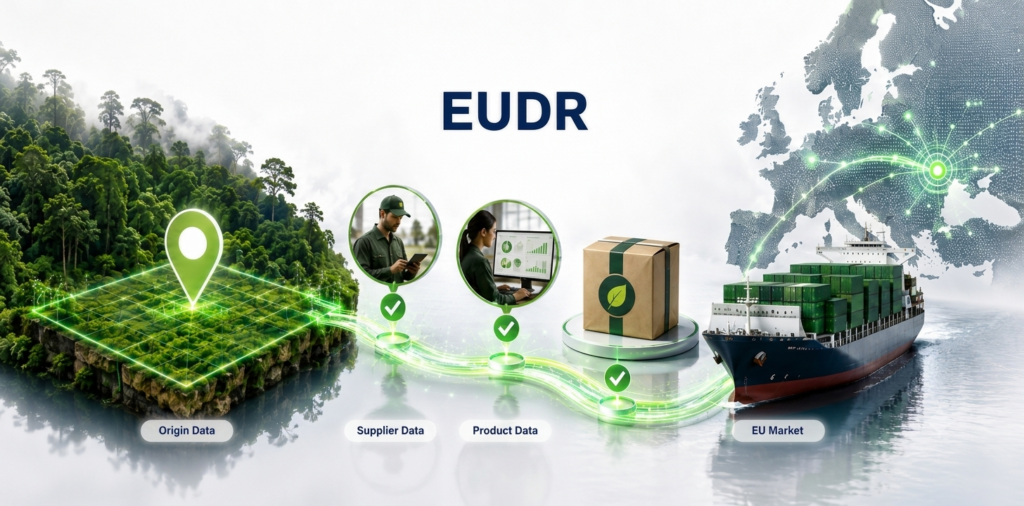
To achieve EUDR compliance, businesses must reliably collect and link four critical categories of information for every relevant product and shipment:
- Exact Place of Origin: Geolocation data—down to the precise plot of land (and plot boundaries for larger areas)—where the raw materials were harvested or produced.
- Supplier Verification: The full chain of custody, capturing every intermediate supplier, processor, and distributor involved along the way.
- Product & Shipment Mapping: Clear lineage connecting raw batch numbers to finished products and export/import documentation.
- Due Diligence Evidence: Auditable proof confirming legal production, environmental compliance, and verified land rights.
The Hidden Risk: Disconnected Data
The biggest operational vulnerability for most organizations isn’t necessarily a bad supply chain—it’s fragmented data.
When supplier credentials live in procurement emails, origin coordinates are stored in supplier spreadsheets, and shipping details reside in an isolated ERP system, proving compliance becomes a slow, error-prone ordeal. Even if your product is 100% sustainable and legally sourced, if your data cannot prove it seamlessly, your shipment faces delays, heavy financial penalties, or total market access denial.
“In the EUDR era, traceability is not what you know—it is what your data can prove.” |
Building One Trusted, Traceable Flow of Data
Overcoming this hurdle requires moving away from reactive, manual compliance efforts. Businesses need an automated, end-to-end data architecture that creates a single source of truth across the supply chain.
Key Capabilities of an EUDR-Ready Data Flow:
- Precision Mapping & Validation: Automatically ingest and validate geographic coordinates (latitude/longitude points and polygons) to verify land status against deforestation baseline dates.
- Supplier Data Integration: Standardize data collection across diverse supplier networks, eliminating reliance on fragmented email threads.
- End-to-End Lineage: Link physical product movements to digital evidence records in real time.
- Audit Readiness: Generate compliant Due Diligence Statements (DDS) efficiently before goods hit the market.
How Xpert Data Works Can Help
Navigating complex compliance frameworks shouldn’t slow down your core operations. At Xpert Data Works, we specialize in helping businesses bridge the gap between complex supply chain realities and rigorous regulatory demands.
We help enterprise organizations integrate disconnected systems into a unified, traceable data flow—connecting every point from the plot of land to the product entering the EU market. By turning compliance data into a reliable, automated operational asset, we ensure your business stays compliant, competitive, and audit-ready.
Ready to secure your European market access? Don’t let fragmented spreadsheets compromise your supply chain. Ensure your products and your data are fully prepared for EUDR requirements. Contact Xpert Data Works today to build your traceable data architecture. |