
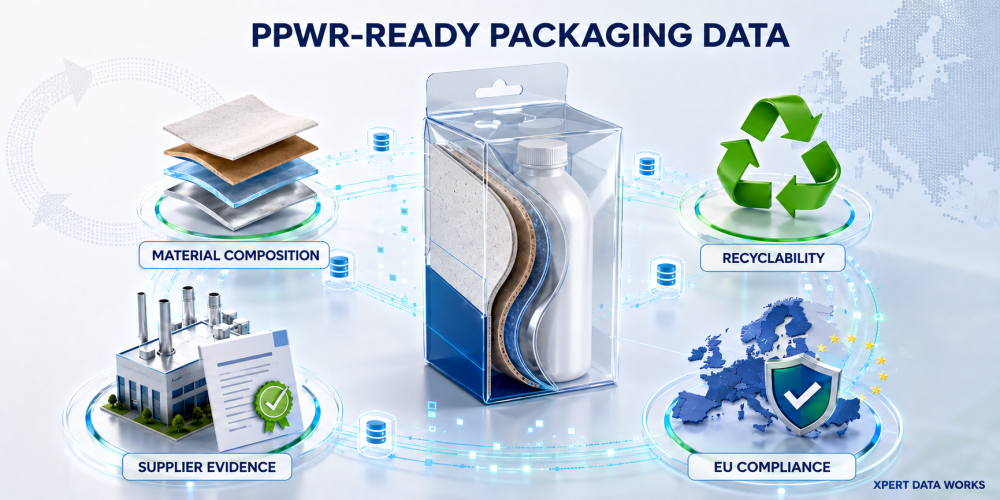
Why Data Is the New Compliance Benchmark
Packaging has traditionally been evaluated on physical attributes: structural integrity, shelf appeal, barrier protection, and cost. However, the European Union’s Packaging and Packaging Waste Regulation (PPWR) fundamentally shifts this paradigm. Today, packaging compliance is no longer solely about the physical material—it is about the granular data backing every single component.
A package might meet design specifications on the manufacturing floor, but without verifiable, accessible, and structured data, it risks being non-compliant in the eyes of regulatory bodies. The central challenge of PPWR is transforming every product wrapper, bottle, and box into a transparent, audit-ready dataset.
The Data Challenge Behind PPWR Requirements
PPWR enforces strict targets on recyclability, recycled content, waste reduction, and material traceability. Meeting these standards requires answering precise questions for every packaging SKU across your portfolio:
- Material Composition: What exact materials, polymers, or composite layers are used, and in what precise weights?
- Recyclability & Recycled Content: What percentage of the package is recyclable in practice, and what is the exact percentage of post-consumer recycled (PCR) material?
- Supplier Evidence: Which tier-1 or tier-N supplier provided the material, and do you have verified documentation, declarations, or laboratory test results to prove it?
- Geographic Compliance: Which regional markets accept this specific material blend under local waste management infrastructures?
For many organizations, the answers to these questions are fragmented. Essential data points sit trapped in disconnected Product Information Management (PIM) systems, Master Data Management (MDM) platforms, static PDFs, legacy ERPs, or scattered email threads with suppliers.
When packaging data is siloed, even a minor design modification—such as swapping a film layer or altering a closure—triggers a slow, manual compliance audit. Relying on manual spreadsheets in a fast-evolving regulatory environment creates massive operational friction and increases the risk of market delays, costly penalties, or supply chain bottlenecks.
Building a Single Source of Truth for Packaging Data
Achieving compliance at scale demands moving away from reactive data collection toward proactive data governance. To build a robust framework for PPWR, enterprises must focus on three core operational pillars:
- Data Integration and Standardization: Integrating supplier data directly into enterprise master data workflows ensures that material declarations, sustainability metrics, and packaging attributes follow a uniform structure across all product lines.
- Audit-Proof Traceability: Regulatory compliance relies heavily on proof. Establishing clear lineage between packaging components, certification documents, and supplier records guarantees that every data point can be independently audited.
- Cross-Functional Accessibility: Packaging data cannot remain isolated within quality assurance or regulatory teams. Procurement, product design, marketing, and supply chain teams need real-time access to packaging master data to make informed decisions before products reach the production phase.
Turning Regulatory Compliance into Strategic Advantage
While PPWR is driven by mandatory European requirements, the underlying capabilities required to comply offer broader business value. Companies that invest in structured packaging data governance gain clear operational advantages:
- Faster Time-to-Market: Standardized material libraries allow product teams to verify compliance during the design phase rather than resolving issues late in the development cycle.
- Supplier Accountability: Structured data exchange streamlines supplier onboarding, simplifies annual audits, and enforces transparency across deep supply chains.
- Smarter Circular Decisions: Precise insights into material weights, recyclable fractions, and carbon footprints allow companies to optimize packaging portfolios for cost and environmental impact simultaneously.
The Path Forward
Under the new regulatory landscape, a physical package is only as compliant as the digital infrastructure supporting it. Organizations that treat packaging data as an isolated compliance task will struggle with administrative overhead and regulatory friction. Conversely, those that embed structured packaging data into their broader Master Data Governance and Supplier Intelligence strategies will navigate regulatory shifts with confidence.
Xpert Data Works helps enterprises connect, standardize, and govern their packaging data—building the reliable foundation necessary for seamless PPWR compliance, audit readiness, and smarter supply chain management.
Is your packaging data structured to meet the future of global compliance? Connect with our team to evaluate your data readiness.