
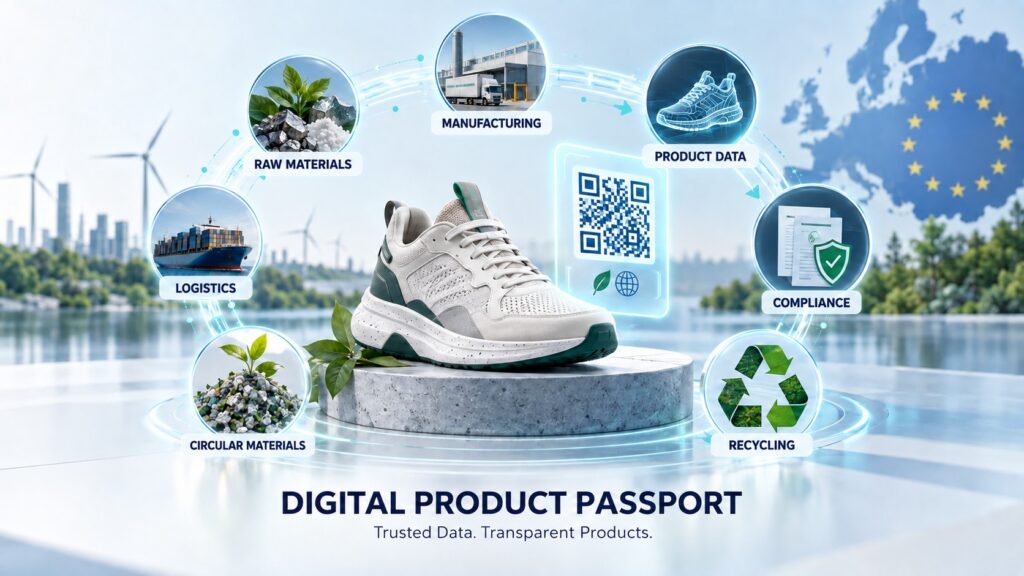
For decades, consumer interaction with physical products ended at the point of sale. You bought a shirt, an electronic device, or a piece of industrial hardware, and its past remained entirely opaque. Where were its raw materials mined or grown? Under what labor conditions was it assembled? How much recycled content does it truly contain, and how should it be disposed of at the end of its useful lifespan?
In today’s market, this opacity is no longer acceptable. Consumers, investors, and regulatory bodies demand radical transparency across every stage of the product lifecycle. A product can no longer be defined merely by its utility or current physical form—it must tell its complete story.
“A product should tell its complete story—not just what it is, but where it came from, what it contains, and how it can be reused or recycled.”
This fundamental shift toward cradle-to-cradle accountability forms the bedrock of the Digital Product Passport (DPP). Emerging regulations, led by the European Union’s Ecodesign for Sustainable Products Regulation (ESPR), are making DPPs a mandatory requirement across multiple key industries. Yet, as organizations scramble to achieve compliance, many are falling into a dangerous trap: viewing the passport as a front-end hardware challenge rather than an enterprise data challenge.
1. The Illusion of the Front End: It’s Not About the QR Code
When business leaders picture a Digital Product Passport, they often visualize the physical carrier: a scannable QR code laser-etched onto a chassis, an RFID tag embedded in a garment, or a data-matrix code printed on packaging. While these data carriers are essential bridges between physical items and digital records, focusing solely on the scannable interface is a classic case of putting the cart before the horse.
A QR code is merely a doorway. If a user scans that code and lands on a page with incomplete material disclosures, outdated compliance certificates, or unverified supply chain claims, the passport fails. Worse yet, publishing inaccurate or unbacked claims exposes manufacturers to severe legal penalties, greenwashing accusations, and permanent brand erosion. DPP readiness does not begin with an RFID tag or a QR code—it begins with trusted, verifiable data.
2. Unpacking the Complexity: What Does a DPP Really Require?
To understand why data governance is the true engine of DPP compliance, one must look at the sheer breadth of information required to populate a single passport. A complete Digital Product Passport consolidates multi-tier data points that historically existed in complete isolation from one another:
- Material Composition & Chemical Safety: Granular breakdowns of raw materials, chemical inventories, REACH/RoHS compliance, and the exact proportion of post-consumer recycled content.
- Provenential & Supplier Lineage: Full multi-tier traceability mapping Tier-1 assemblers down to Tier-N raw material extractors, including ethical labor audit records.
- Environmental Impact & Carbon Footprint: Verified Life Cycle Assessment (LCA) metrics, embodied carbon calculations, water footprint data, and energy intensity figures.
- Circularity & End-of-Life Guidance: Clear disassembly instructions, component repairability scores, spare parts availability, and step-by-step instructions for recyclers.
3. The Core Challenge: Overcoming Data Fragmentation
Inside most manufacturing organizations, this information exists—but it is deeply fragmented. Product material records sit locked inside Enterprise Resource Planning (ERP) databases. Chemical compliance documentation lives in third-party vendor portals. Engineering specifications are buried in Product Lifecycle Management (PLM) tools, and circularity guidelines reside in static PDF manuals.
Attempting to manually aggregate this enterprise-wide information for thousands of SKUs leads to missing records, conflicting data formats, and catastrophic operational bottlenecks. Without a unified data foundation, maintaining up-to-date product passports across dynamic global supply chains becomes an impossible operational burden.
4. How Xpert Data Works Bridges the Compliance Gap
At Xpert Data Works, we address the root cause of the DPP compliance bottleneck. We don’t just focus on the final display; we build the robust data architecture that makes product transparency possible.
Our core expertise lies in connecting product, supplier, material, and compliance data into a single, cohesive ecosystem. We help enterprise organizations:
- Harmonize Siloed Systems: Integrate disparate ERP, PLM, SCM, and ESG tracking software into a synchronized master data layer.
- Automate Supplier Data Ingestion: Streamline the collection and validation of Tier-N supplier certifications, ensuring upstream transparency.
- Establish Data Governance & Auditability: Implement rigorous data governance practices so every data point in your product passport is fully auditable, accurate, and compliance-ready.
5. Turning Compliance into a Competitive Advantage
Digital Product Passports should not be viewed merely as a regulatory tax. When executed with high-fidelity, trusted data, DPPs become a powerful strategic asset. Companies that master product story-telling build deeper brand loyalty, satisfy eco-conscious consumers, streamline circular business models (such as remanufacturing and take-back programs), and de-risk their regulatory exposure.
The future of manufacturing belongs to products that can speak for themselves. Ensure your products tell a true story. Partner with Xpert Data Works to transform your scattered enterprise information into reliable, passport-ready records today.