
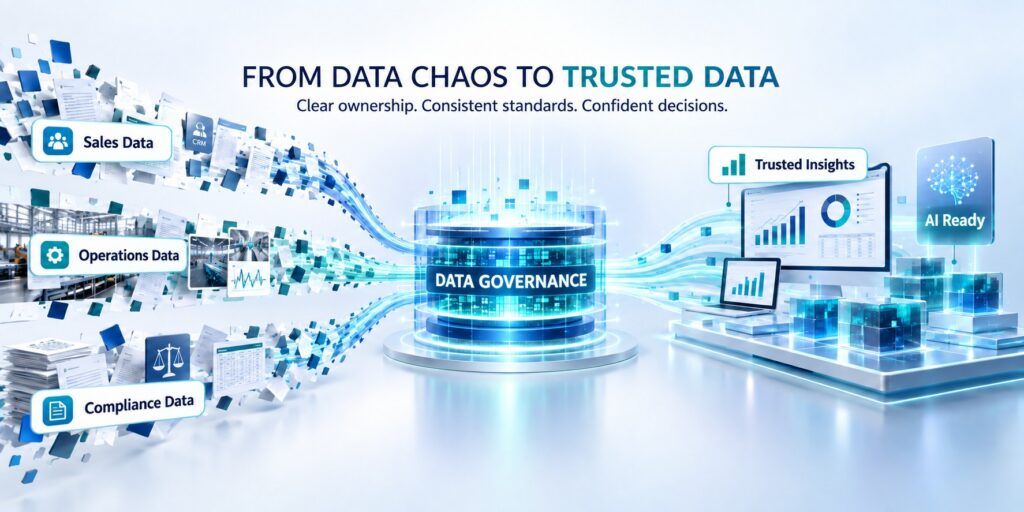
In today’s hyper-connected enterprise, data is no longer confined to neat, isolated silos. It flows continuously across departments, tools, and platforms. On any given day, your Sales team updates customer details in the CRM to reflect a recent conversation. Operations relies on an entirely different database to manage fulfillment and logistics. Meanwhile, Compliance scrambles to locate audit trails, trying to figure out which record represents the official truth.
And now, there is a powerful new player in the ecosystem: Artificial Intelligence.
Modern AI models, machine learning algorithms, and internal chatbots ingest data from every corner of the organization. They consume every entry, edit, and typo—regardless of whether that information is accurate, updated, or legally compliant.
This daily reality raises a fundamental question every modern business leader must answer: Who actually owns the data when everyone uses it?
Without a clear answer, organizations face operational friction, regulatory exposure, and unreliable AI outcomes. Resolving this challenge is where modern data governance becomes essential.
The Hidden Friction of Disconnected Data
When ownership is undefined, data drift is inevitable. Different departments inevitably create their own versions of reality based on their unique daily goals:
- Sales prioritizes speed, pipeline tracking, and rapid deal execution. Their updates often prioritize immediate customer interaction over long-term data cleanliness.
- Operations requires strict accuracy for fulfillment, inventory control, and supply chain logistics, building specialized processes around operational metrics.
- Compliance & Risk Management must trace data back to its origin, verifying authorization, privacy rights, and regulatory alignment.
When these teams operate without a unified standard, the organization creates fragmented information streams. When Sales and Operations operate off conflicting customer records, delivery delays occur, reporting discrepancies multiply, and strategic decision-making suffers.
When AI enters this environment, the consequences compound quickly. AI systems lack human intuition—they cannot infer intent or automatically filter out outdated inputs. If fed contradictory or poorly managed inputs, AI will generate untrustworthy insights, flawed forecasts, and inaccurate automated actions. In short: Garbage in, unreliable AI out.
Moving Beyond ‘Data Hoarding’ to Clear Data Ownership
Solving the ownership dilemma does not mean assigning complete responsibility to a single department or expecting the IT team to act as sole custodians of every field in every database.
Effective data ownership is built on clear roles, shared accountability, and transparent standards across three primary layers:
- Data Domain Owners: Business leaders who understand the context of specific data domains (e.g., Customer Data, Product Data, Financial Data). They define business rules, access privileges, and acceptable usage criteria.
- Data Stewards: Subject matter experts embedded within business units who manage day-to-day data hygiene, resolve definitions, and enforce consistency.
- Data Custodians (IT & Data Engineering): Technical teams responsible for maintaining infrastructure, data pipelines, security architectures, and system performance.
When these roles are clearly established, data transitions from a confusing, shared resource into a well-managed asset with clear accountability at every stage of its lifecycle.
Data Governance: Enabling Progress, Not Restricting It
A common misconception is that data governance exists to lock down information, slow down innovation, and add bureaucracy to everyday workflows. Traditional governance often felt like a series of rigid rules designed to say ‘no.’
Modern data governance does the exact opposite. Rather than restricting data access, strong governance creates the structural trust required to democratize data safely.
When employees know where data comes from, how it is defined, and who is responsible for it, they can act on it with complete confidence. Good data governance provides:
- Consistent Definitions: Ensuring that key metrics—such as ‘Active Customer,’ ‘Monthly Recurring Revenue,’ or ‘Order Fulfillment Time’—are calculated identically across every department.
- Lineage & Traceability: Giving Compliance and audit teams full visibility into where data originated, how it transformed, and who modified it.
- Data Quality Standards: Establishing automated validation checks to flag errors before bad data reaches reporting dashboards or AI training sets.
- Confidence for AI Initiatives: Providing clean, contextualized, and compliant datasets that allow internal language models and predictive algorithms to deliver safe, accurate results.
How Xpert Data Works Transforms Enterprise Data
At Xpert Data Works, we specialize in turning fragmented, disconnected data systems into trusted business assets. We help organizations bridge the gap between technical infrastructure and business strategy by designing governance frameworks tailored to real-world operational needs.
We partner with organizations to:
- Establish Clear Ownership: Define pragmatic governance frameworks that assign accountability without creating administrative bottlenecks.
- Unify Disconnected Data: Standardize data definitions, metadata, and quality metrics across Sales, Operations, Finance, and Compliance.
- Ensure Compliance Readiness: Build transparent data lineage and audit tracks that simplify regulatory reporting and risk mitigation.
- Prepare Data for AI: Clean, structure, and secure enterprise datasets so AI tools operate on trusted foundation data.
Confident Data Drives Confident Decisions
When everyone uses data, no single person can simply ‘own’ it in isolation. Ownership must be built into the operational framework of your organization through transparent governance, clear stewardship, and shared standards.
Data governance isn’t about building barriers—it’s about enabling your organization to move faster, make smarter decisions, and deploy advanced AI solutions with total confidence.
Ready to transform your disconnected data into your most trusted asset? Reach out to Xpert Data Works today.
#DataGovernance #TrustedData #DataQuality #AIReady #XpertDataWorks
Leave a Reply